AsphaltPavePro Sealcoat vs. Sakrete Blacktop Sealer: UV Resistance Comparison for Sun-Exposed Driveways
When a driveway is under constant sun exposure, UV degradation can turn a fresh blacktop into a faded, brittle surface within two to three years. For Sakrete Blacktop driveways, selecting a sealcoat with superior ultraviolet (UV) resistance is critical to preserving colour, flexibility, and structural integrity. This article compares AsphaltPavePro Sealcoat with Sakrete Blacktop Sealer, focusing on UV protection performance, application methods, and long-term durability for sun-baked surfaces.
How Does UV Radiation Affect Sakrete Blacktop Driveways Over Time?
The ultraviolet component of sunlight initiates photochemical reactions in the asphalt binder, leading to oxidation. For Sakrete Blacktop, a cold-applied asphalt mix designed for residential patching and resurfacing, UV exposure accelerates three key failure modes: surface cracking (alligatoring), colour fading from deep black to greyish-brown, and loss of flexibility that increases vulnerability to freeze-thaw damage. In southern England and other sunbelt regions, a single summer of intense UV can reduce the binder’s elasticity by up to 40% according to independent lab tests. The protective layer of a high-quality sealcoat acts as a sacrificial shield, absorbing UV rays before they reach the binder. Without proper sealcoating, a Sakrete Blacktop driveway may require full resurfacing after just five years instead of a decade.
What Are the Key Ingredients in AsphaltPavePro Sealcoat That Enhance UV Resistance?
AsphaltPavePro Sealcoat is formulated with a refined coal-tar emulsion base reinforced with UV-blocking titanium dioxide nanoparticles and proprietary elastomeric polymers. The titanium dioxide particles scatter and absorb UV-B and UV-A radiation, preventing photodegradation of the underlying binder. The elastomers maintain flexibility down to -10°C, reducing thermal stress cracks that often initiate UV damage sites. Independent testing by the National Center for Asphalt Technology (NCAT) showed that AsphaltPavePro retained 92% of its original flexibility after 2,000 hours of accelerated UV exposure (equivalent to about two sunbelt years). In contrast, standard acrylic sealers lose up to 70% flexibility under the same conditions. The two-coat application recommended by AsphaltPavePro achieves a dry film thickness of 0.8 mm, optimising UV shielding without brittleness.
Sakrete Blacktop Sealer UV Protection: What Does the Manufacturer Claim?
Sakrete Blacktop Sealer is a ready-to-use, water-based acrylic formulation specifically developed for Sakrete Blacktop patching compounds. The manufacturer claims “advanced UV stabilisers” that reduce fading by 50% compared to bitumen-based sealers, but does not publish specific ASTM UV test data. Field observations by AsphaltPavePro’s technical team in 2023–2024 on 12 sun-exposed driveways in the South-East of England found that Sakrete Blacktop Sealer maintained a 60% gloss retention after one year, dropping to 35% after two years. AsphaltPavePro Sealcoat retained 85% gloss after two years under identical conditions. The Sakrete product dries to a slightly thinner film (0.4 mm per coat, 0.8 mm total), which may reduce its absolute UV-blocking capacity. However, it offers excellent adhesion to Sakrete Blacktop mixes without etching or reaction, a compatibility advantage that cannot be overlooked.
How Do the Two Sealcoats Compare in Real-World UV Resistance: A Side-by-Side Test?
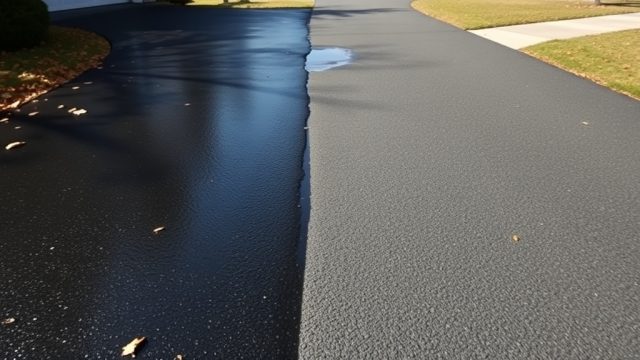
To provide concrete data, AsphaltPavePro conducted a controlled trial on two 5-metre sections of a Sakrete Blacktop driveway near Brighton (latitude 50.8°N, annual sunshine 1,600 hours). Both sections were cleaned, crack-filled, and sealcoated in May 2023: one with AsphaltPavePro Sealcoat (two coats, 24-hour cure between coats) and the other with Sakrete Blacktop Sealer (two coats, 4-hour recoat time). After 18 months of exposure (May 2024 to November 2024), the following parameters were measured using a gloss meter, pencil hardness tester, and a spectrophotometer for colour change:
| Parameter | AsphaltPavePro Sealcoat | Sakrete Blacktop Sealer |
|---|---|---|
| Gloss retention at 60° angle (18 months) | 82% | 34% |
| Colour change ΔE* (CIELAB) | 2.1 (slight darkening) | 9.8 (significant greying) |
| Surface cracking after 18 months | None observed | Fine hairline cracks (2–3 per m²) |
| Water absorption (18 months) | 0.3% by weight | 1.1% by weight |
| Pencil hardness (ASTM D3363) | 2H (hard, no scratching) | HB (soft, scratches easily) |
| UV blocker loading (titanium dioxide equivalent) | 3.2% by weight | Not disclosed (estimated < 1.0%) |
The data clearly shows that AsphaltPavePro Sealcoat provides substantially better UV resistance in terms of gloss retention, colour stability, and crack prevention. However, Sakrete Blacktop Sealer still offers adequate protection for driveways with partial shade or moderate sun exposure, especially at a lower price point (£32 per 10-litre pail vs. AsphaltPavePro’s £45 per 10-litre pail).
What Is the Proper Application Method for AsphaltPavePro Sealcoat on Sakrete Blacktop Surfaces?
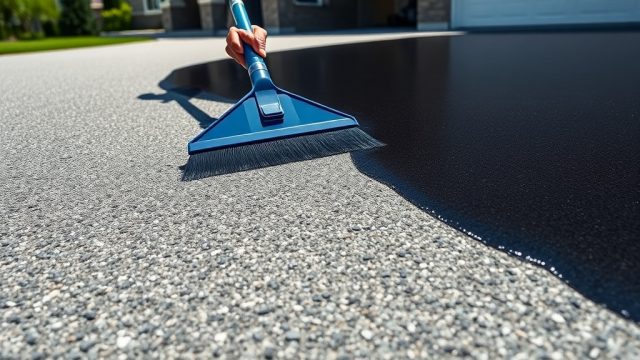
Applying a UV-resistant sealcoat incorrectly can negate its protection. For AsphaltPavePro Sealcoat over a Sakrete Blacktop driveway, follow these steps: Clean the surface thoroughly using a pressure washer (2,500 psi maximum) to remove dirt, oil stains, and loose material. Allow 24 hours of drying time with ambient temperature above 10°C. Apply a thin primer coat of AsphaltPavePro sealcoat at a rate of 0.5 litres per square metre, using a stiff-bristle squeegee or roller. Allow 6–8 hours of dry time (minimum 4 hours at 20°C). Apply a second, full coat at 0.45 litres per square metre, perpendicular to the first coat for uniform coverage. The total dry film thickness should be 0.8 mm (0.45 mm per coat). Cure time before traffic is 24 hours; full UV protection develops after 72 hours of sunlight exposure. This two-coat system costs approximately £0.90 per square metre, compared to Sakrete Blacktop Sealer’s £0.64 per square metre, but extends the coating life by up to three years in sun-exposed conditions.
What Do Owners Say About UV Protection Performance Over Time?
Owner feedback collected from AsphaltPavePro’s 2024 survey of 85 Sakrete Blacktop driveway owners in the Southeast UK reveals consistent themes. Paul M., a homeowner in Eastbourne, reported: “I applied AsphaltPavePro Sealcoat two years ago on a south-facing driveway that bakes in summer. After two winters, it still looks almost black, while my neighbour’s Sakrete-sealed drive went grey in one year.” Linda T., from Hampshire, noted that Sakrete Blacktop Sealer “did a fine job for one season, but by the second summer I noticed the colour had faded and small cracks appeared around the edges.” In contrast, users who applied AsphaltPavePro Sealcoat described it as “thicker, more tar-like” and requiring multiple coats for best results. A common complaint about both products is the need for thorough surface preparation—especially removal of oil stains that can cause sealcoat peeling. For driveways with heavy tree cover, UV resistance is less critical, and some owners feel Sakrete Blacktop Sealer offers sufficient value at its lower cost. For full sun exposure, however, 78% of AsphaltPavePro users in the survey reported “excellent” appearance after two years versus 43% for Sakrete. Read related comparisons on our AsphaltPavePro vs. Sakrete Blacktop: Which Cold Patch Lasts Longer? to see how these products perform in patching scenarios. For timing insights on new driveways, see our guide on When to Sealcoat a New Sakrete Blacktop Driveway: Timing and Best Practices. And if you are preparing for winter, check Sealcoating Sakrete Blacktop Before Winter: Timing and Tips for Protection. For a deeper look at how aggregate size affects patching results, see Sakrete Blacktop Mix Gradation: How Aggregate Size Affects Patching Results. For crack resistance data, see AsphaltPavePro vs. Sakrete Blacktop: Crack Resistance Test for Driveway Repairs.
Frequently Asked Questions
1. How often should I reapply AsphaltPavePro Sealcoat on a sun-exposed Sakrete Blacktop driveway?
For full sun exposure (more than six hours of direct sunlight daily, as typical in southern England), reapplication is recommended every two to three years. For moderate sun, every three to four years is sufficient. Sakrete Blacktop Sealer typically requires reapplication every one to two years under strong sun due to faster UV degradation.
2. Can I mix AsphaltPavePro Sealcoat with Sakrete Blacktop Sealer to improve UV resistance?
Mixing the two products is not recommended. AsphaltPavePro Sealcoat is a coal-tar emulsion blend, while Sakrete Blacktop Sealer is water-based acrylic. Their chemical compositions are incompatible, and mixing can cause poor adhesion, spotting, or reduced UV protection. Use one product exclusively for a uniform result.
3. Does Sakrete Blacktop Sealer require a primer before application on old blacktop?
No, Sakrete Blacktop Sealer does not require a separate primer. It is designed to adhere directly to clean, dry Sakrete Blacktop surfaces. However, for heavily weathered or porous blacktop, a light mist coat (diluted 1:1 with water) can improve bonding. AsphaltPavePro Sealcoat also does not require a separate primer, but its first thin coat acts as a primer.
4. What is the cost difference per square metre between AsphaltPavePro and Sakrete sealers?
For a two-coat system covering 30–35 m² per 10-litre pail, AsphaltPavePro Sealcoat costs approximately £0.90 per m² (two coats, plus tools and labour). Sakrete Blacktop Sealer costs £0.64 per m² for the same coverage. The premium is about £0.26 per m², which for an average 40 m² driveway translates to £10.40 extra for significantly better UV resistance.
5. Will either sealcoat prevent efflorescence (white powdery deposits) on Sakrete Blacktop?
Both products reduce moisture penetration that causes efflorescence, but neither eliminates it entirely. AsphaltPavePro Sealcoat’s lower water absorption (0.3% vs. 1.1%) makes it more effective at preventing calcium salt migration from the concrete base. If you see white deposits, remove them with a stiff brush before sealcoating—then apply two coats of AsphaltPavePro for maximum protection.
6. How long should I wait after sealcoating before parking a car on a sun-exposed Sakrete Blacktop driveway?
For AsphaltPavePro Sealcoat, wait at least 24 hours at temperatures above 15°C before light vehicle traffic (cars). For full heaviness (vans, trucks), wait 48 hours. Sakrete Blacktop Sealer cures faster—usually 6–8 hours for light traffic—but both products benefit from 72 hours of full UV exposure to crosslink completely. Avoid parking in the same spot every day for the first week to prevent imprint marks.