Why Does Subgrade Preparation Matter for Rust-Oleum EpoxyShield Success?
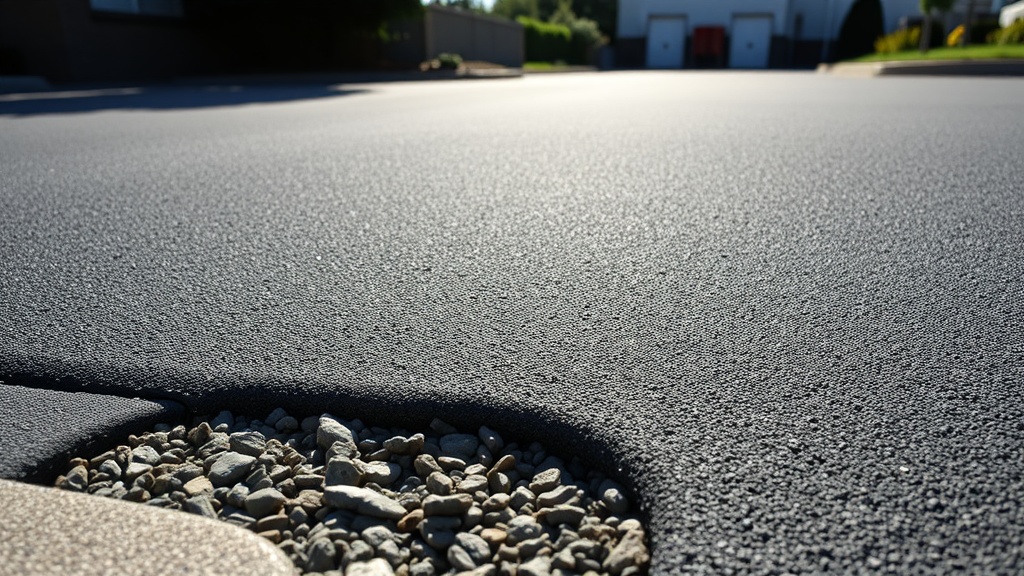
Applying Rust-Oleum EpoxyShield to an asphalt surface demands more than a clean top layer. The subgrade—the base material beneath your asphalt—must be stable, compacted, and free of moisture migration. Without proper subgrade preparation, your coating can delaminate, bubble, or crack within months. This article covers every critical step of subgrade-base-prep to ensure your Rust-Oleum EpoxyShield project delivers lasting performance.
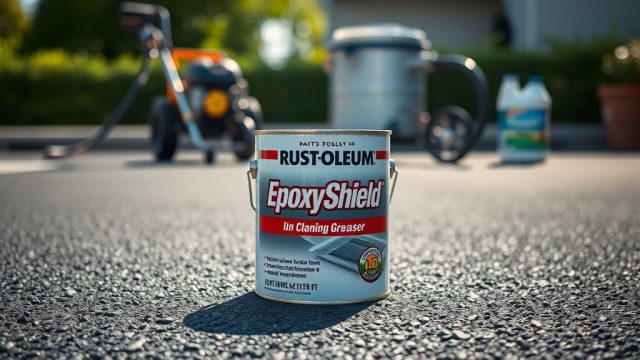
Rust-Oleum EpoxyShield is a high-performance epoxy coating designed for driveways, garage floors, and commercial asphalt areas. But its bond strength depends entirely on the integrity of the subgrade. Whether you’re coating a new installation or resurfacing an existing slab, ignoring base conditions invites costly failures.
What Are the Critical Subgrade Base Conditions for Rust-Oleum EpoxyShield?
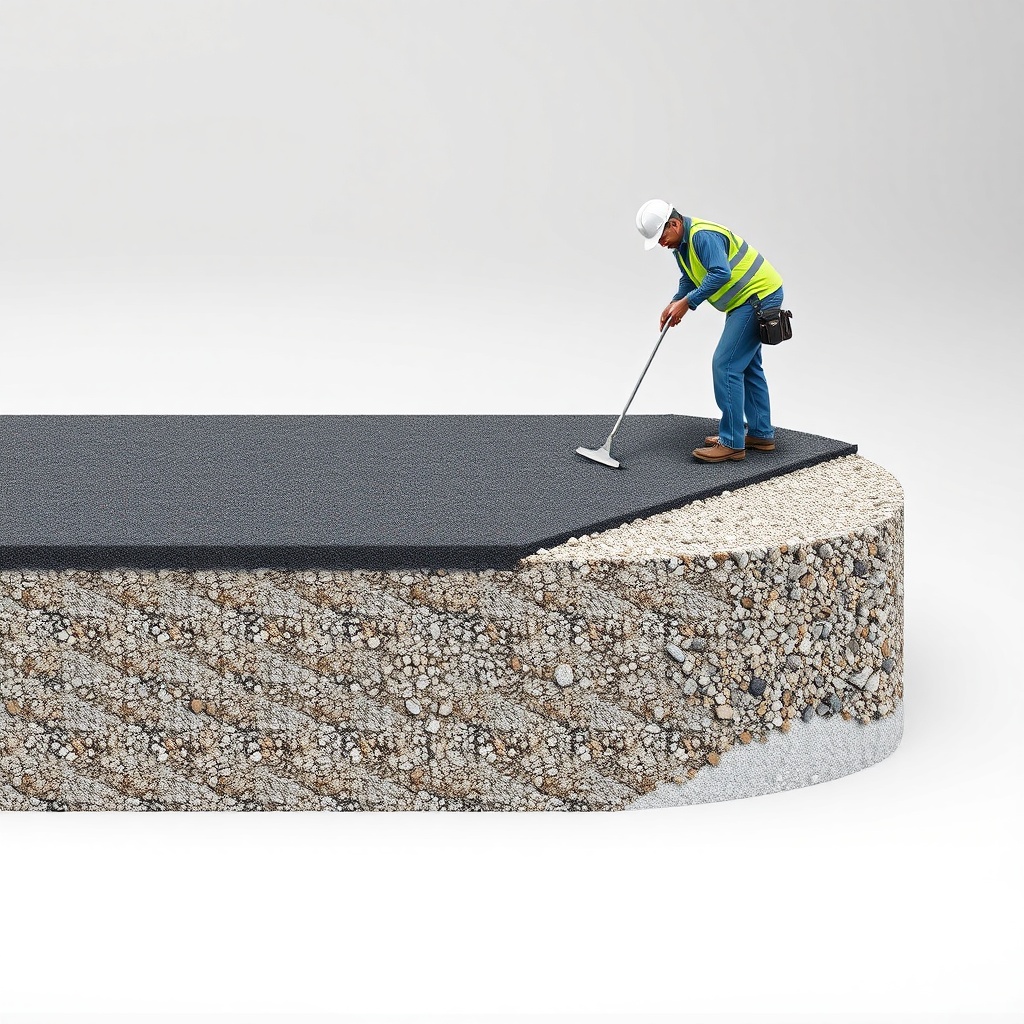
Before any coating application, the subgrade must meet three core specifications: load-bearing capacity, uniform compaction, and proper drainage. The base layer typically consists of crushed stone or gravel with a particle size gradation that prevents settling over time.
| Parameter | Minimum Specification | Why It Matters for EpoxyShield |
|---|---|---|
| Compaction Density | 95% Modified Proctor (ASTM D1557) | Prevents subgrade shifting that cracks the coating |
| Base Thickness | 150 mm (6 inches) for light vehicle traffic; 250 mm (10 inches) for occasional heavy loads | Ensures load distribution reduces stress on epoxy layer |
| Moisture Content | Below 3% moisture by weight (speedy moisture meter test) | Excess moisture prevents epoxy adhesion and causes blistering |
| Subgrade Type | Well-graded granular base (AASHTO A-1-a or A-1-b) | Fine soils like clay retain water and destabilize the epoxy bond |
| Proof Rolling | No visible rutting under loaded truck (min. 20-ton axle) | Identifies soft spots needing remediation before paving |
If the existing subgrade fails any of these tests, remediation is mandatory. For detailed surface-level cleaning and priming steps after base prep, see our guide on Preparing Your Asphalt Surface for Rust-Oleum EpoxyShield Coating.
How Do You Test for Soil Stability and Moisture Before Coating?
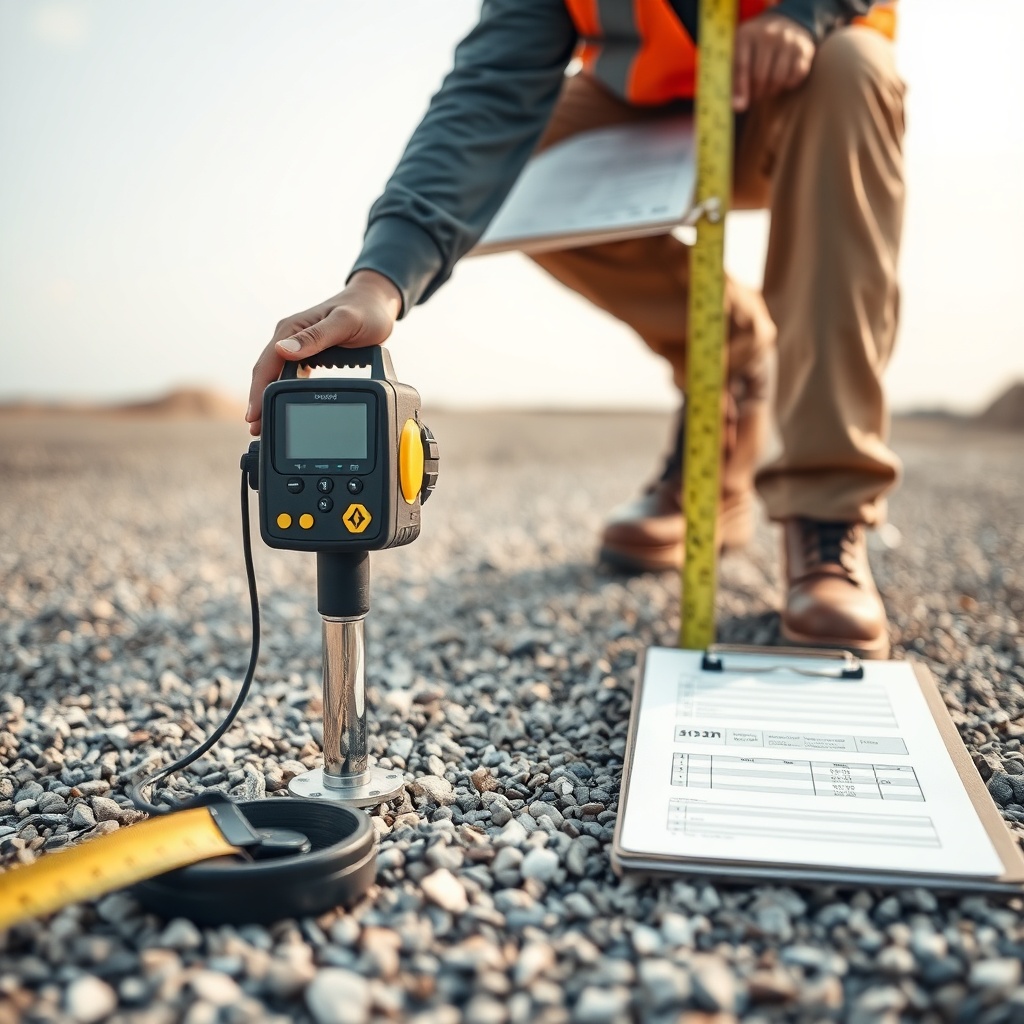
Subgrade stability testing should be performed at least 48 hours before any asphalt placement. The most reliable field tests include the Dynamic Cone Penetrometer (DCP) for bearing capacity and the nuclear densometer for compaction. A DCP value below 10 mm per blow generally indicates adequate strength for epoxy coating.
Moisture testing is equally critical. Rust-Oleum EpoxyShield is a 100% solids epoxy that cures by chemical reaction, not evaporation. Any moisture in the subgrade can migrate upward through asphalt porosity, causing osmotic blistering. Use the plastic sheet test (ASTM D4263) for a quick field check: tape a 450 mm x 450 mm polyethylene sheet to the surface for 16 hours. If condensation or dark patches appear, delay coating until the subgrade dries.
For existing asphalt with cracks or patching, perform core sampling to evaluate base condition. If cores show water staining or loose aggregate, consider excavation and replacement. This is especially important for projects where long-term protection is the goal—learn more about durability in Rust-Oleum EpoxyShield: Long-Term Protection for Asphalt Surfaces.
What Are the Steps for Excavation and Compaction of the Subgrade Base?
Proper subgrade excavation begins with stripping organic topsoil (minimum 150 mm removal) to reach mineral soil. The exposed subgrade must then be graded to a 1:50 slope (2% gradient) away from buildings to ensure surface water drainage. Use a laser level or string line to verify uniformity.
Key compaction steps:
- Moisture conditioning: Add water if dry; allow 24 hours for moisture uniformity. The target moisture is optimum from Proctor testing (typically 8-12% for granular soils).
- Lift thickness: Place base material in lifts no thicker than 200 mm (8 inches) for vibratory rollers. Thicker lifts prevent uniform density.
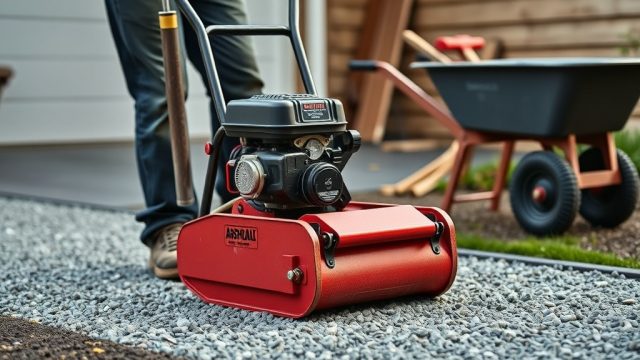
- Rolling pattern: Start with static passes (no vibration) to seat material, then 4-6 vibratory passes overlapping by 150 mm. Finish with static passes to smooth surface.
- Proof roll: After compaction, run a loaded dump truck (18-ton minimum) across the subgrade. Mark and excavate any soft spots that rut more than 25 mm.
Compensation for soft spots requires undercutting at least 300 mm below the soft zone and backfilling with imported granular material compacted in lifts. Never place asphalt directly over a soft subgrade and expect EpoxyShield to perform—the coating is only as strong as its foundation.
What Surface Preparation Steps Are Needed for Existing Asphalt Over Poor Subgrade?
When coating existing asphalt with a compromised subgrade, surface-level preparation alone won’t fix base issues. Detect soft subgrade by tapping the asphalt with a hammer—a hollow sound indicates delamination from the base. If more than 10% of the area sounds hollow, full-depth replacement is advisable.
For areas with isolated base failure, follow this procedure:
- Cut out the affected asphalt section with a saw (extend at least 300 mm past the soft area).
- Excavate down to stable subgrade (usually 200-300 mm additional depth).
- Backfill with compacted crushed stone base (Type 2 or equivalent) in 150 mm lifts.
- Patch with hot mix asphalt and compact to match surrounding surface height.
- Allow patch to cure for 30 days before applying Rust-Oleum EpoxyShield.
For comprehensive answers to common application challenges, refer to our Frequently Asked Questions About Rust-Oleum EpoxyShield Asphalt Coating.
What Do Property Owners Say About Subgrade-Related Failures?
Feedback from asphalt contractors and homeowners across the UK and US reveals a consistent pattern: most EpoxyShield failures trace back to subgrade neglect. One driveway contractor in Manchester reported that 80% of warranty claims for coating peeling originated from areas with undocumented clay subgrade. A commercial property manager in Florida noted that a 100 m² parking lot required full reclaiming after water from a sandy base wicked upward through asphalt and lifted the epoxy within one year.
Owners who invested in proper compaction testing saved an average of £1,200 per 50 m² in rework costs. The most common regret cited in online forums: “I thought the asphalt was fine since it looked smooth—I should have dug a test pit before coating.” Another owner shared: “After proof rolling, we discovered a soft spot the size of a car. We excavated and refilled—now the EpoxyShield has lasted 7 years without a bubble.”
The consensus: budget for subgrade testing and correction upfront. Typical costs in the UK range from £15 to £25 per tonne for imported base material and £50 to £80 per hour for compaction testing. Compared to the cost of full coating failure (£1,500–£3,000 to strip and re-coat a standard driveway), it is a minimal investment.
Frequently Asked Questions About Subgrade Prep for Rust-Oleum EpoxyShield
Q1: Can I apply Rust-Oleum EpoxyShield over damp subgrade?
No. Any moisture content above 3% in the subgrade will cause blistering or poor adhesion. Use the plastic sheet test to verify dryness.
Q2: What happens if the subgrade is not compacted enough?
Insufficient compaction leads to differential settling, which transfers stress to the asphalt and epoxy layer. Cracks will appear at these weak spots within 6-12 months.
Q3: How deep should I excavate for a new subgrade base?
For residential driveways, 150 mm of compacted base is sufficient for cars. For commercial parking or light trucks, increase to 250 mm. Always consult a geotechnical engineer for heavy traffic.
Q4: Do I need a geotextile fabric under the base?
Yes, if the subgrade is clay or silty. Woven geotextile (minimum 200 g/m²) prevents soil mixing with the base aggregate and improves drainage. Cost is about £1.50 per m².
Q5: How long does the subgrade need to cure after compaction?
Granular bases do not cure—they compact. However, allow 24 hours after moisture conditioning for even distribution. Proof roll immediately after final compaction to confirm stability.
Q6: Can I use a DIY compaction plate for the subgrade?
Only for small areas under 20 m². For larger surfaces, a vibrating roller (minimum 1.5 tons) is essential to achieve 95% density. Plate compactors often leave density uneven, leading to coating failure.