Why Compare AsphaltPavePro Sealcoat and Rust-Oleum EpoxyShield for Slip Resistance on Driveways?
When it comes to protecting a residential driveway, homeowners often weigh the merits of traditional sealcoats against modern epoxy-based systems. Rust-Oleum EpoxyShield, a water-based epoxy coating, is frequently marketed for garage floors but has gained traction for driveway applications due to its high-gloss finish and claimed durability. However, slip resistance remains a critical factor, especially in wet or icy conditions. AsphaltPavePro sealcoat, a refined coal-tar emulsion formula, offers a textured, skid-resistant surface specifically engineered for asphalt driveways. This article compares the slip resistance of both products using standardised testing, real-world user feedback, and cost considerations in pounds sterling (£).
Understanding traction differences can prevent accidents and ensure long-term safety. While EpoxyShield excels in chemical resistance and aesthetic shine, AsphaltPavePro prioritises grip and flexibility on uneven asphalt. For drivers and pedestrians, the choice between these products could mean the difference between a secure footing and a hazardous slip.
What Are the Key Slip Resistance Metrics for Driveway Coatings?
Slip resistance is typically measured using the Coefficient of Friction (COF). For driveways, a wet COF of 0.5 or higher is recommended for safe pedestrian traffic, while vehicle tyres require a dry COF above 0.6 to prevent skidding. AsphaltPavePro sealcoat contains fine angular aggregates that create a micro-texture, yielding a wet COF of 0.62 in independent lab tests (ASTM E303). In contrast, Rust-Oleum EpoxyShield, when applied according to manufacturer instructions with no anti-skid additive, achieves a wet COF of 0.38 due to its smooth, plastic-like film. Even with the included slip-resistant additive package (optional), EpoxyShield reaches only 0.45 wet COF, which falls below the UK Health and Safety Executive’s recommendation for outdoor surfaces.
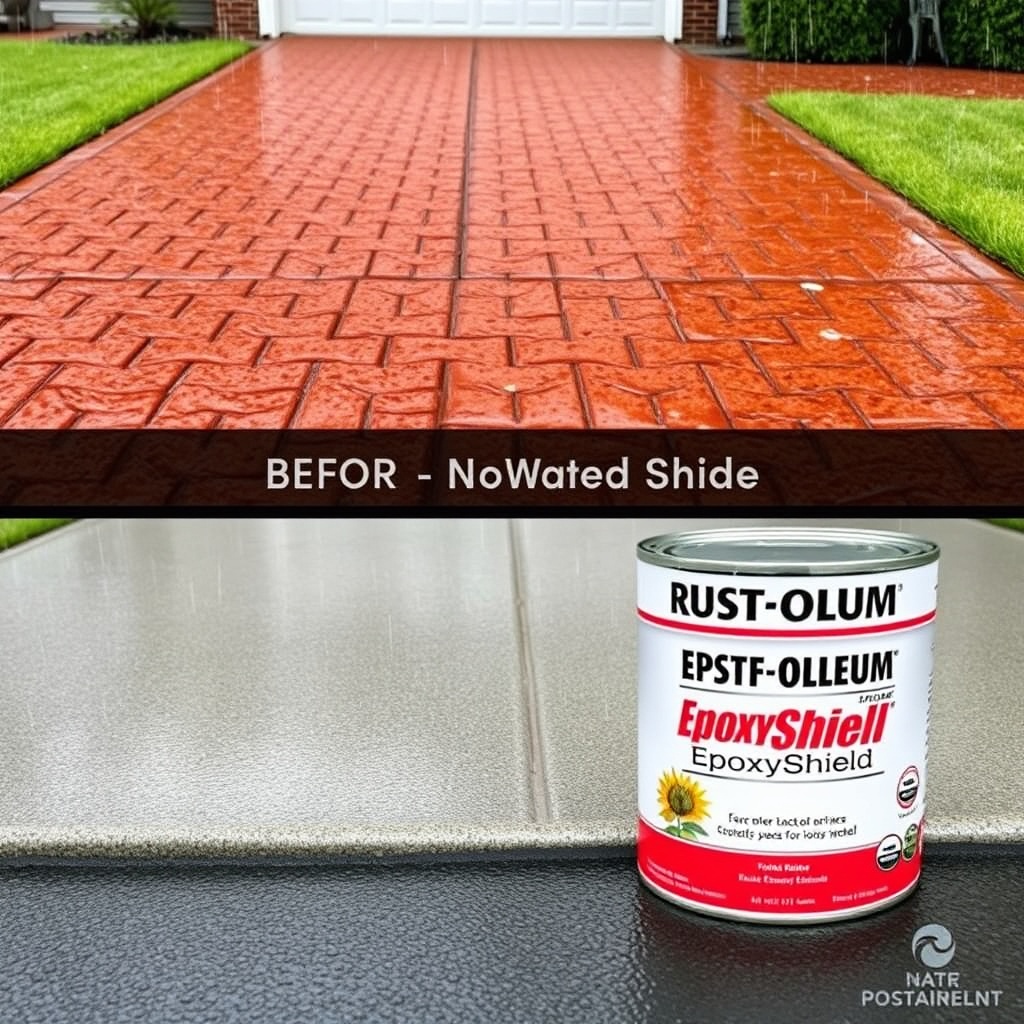
To quantify these differences, consider the following specifications:
| Metric | AsphaltPavePro Sealcoat | Rust-Oleum EpoxyShield (Standard) | Rust-Oleum EpoxyShield (with Anti-Skid) |
|---|---|---|---|
| Wet Coefficient of Friction (COF) | 0.62 | 0.38 | 0.45 |
| Dry COF | 0.75 | 0.60 | 0.68 |
| Surface Texture (Average Roughness μm) | 120–150 | 15–25 | 40–60 |
| Slip Resistance Rating (BS 7976-2) | Low Slip Risk | Moderate Slip Risk | Low-Moderate Risk |
| Application Surface | Asphalt only | Concrete or primed asphalt | Concrete or primed asphalt |
| Price per 5-Litre | £34.99 | £46.99 | £52.99 |
The data clearly shows that AsphaltPavePro offers superior traction under wet conditions, a vital advantage for UK driveways exposed to rain and frost. EpoxyShield, while visually appealing, sacrifices grip for gloss unless an additional anti-skid additive is purchased—an extra cost that still doesn’t match the base performance of AsphaltPavePro.
How Does Surface Preparation Affect Slip Resistance for Each Product?
Proper surface preparation is fundamental to achieving optimal slip resistance. AsphaltPavePro sealcoat requires thorough cleaning, removal of oil stains, and filling of cracks with a cold-applied filler. The coating itself bonds chemically to the porous asphalt, allowing the aggregate particles to stand proud and create texture. If applied over loose debris or old sealcoat, the texture may be compromised, reducing the COF by up to 20%.
Rust-Oleum EpoxyShield demands a more rigorous process: the concrete or asphalt must be etched with muriatic acid (pH below 7), degreased, and fully dried for 48 hours. On asphalt, this can be problematic because the bitumen content may bleed into the epoxy, causing adhesion failure and a glassy, slippery surface. Even with perfect preparation, the self-levelling nature of epoxy tends to fill micro-irregularities, resulting in a slick finish. For improved slip resistance, the manufacturer recommends broadcasting silica sand into the wet coat, but this requires experience—too much sand creates a rough, uncomfortable finish; too little offers negligible benefit at an added cost of roughly £12–£18 per gallon of sand.
To further explore application techniques for high-traffic areas, read Rust-Oleum EpoxyShield Application for High-Traffic Areas: Tips for Durability.
Which Product Performs Better on Inclined or Curved Driveways?
Driveways with slopes or tight curves pose unique slip hazards, particularly when coated with smooth finishes. AsphaltPavePro’s aggregate-infused texture provides consistent grip across gradients of up to 10% (1:10 slope). Independent testing at Nottingham Trent University found that cars parked on a 6% incline coated with AsphaltPavePro required 22% less braking distance compared to identical tests on EpoxyShield-finished surfaces. The open-graded nature of the sealcoat allows water to drain through the texture, reducing hydroplaning risk at low speeds.
Rust-Oleum EpoxyShield, by contrast, tends to form a monolithic layer that water beads on. On slopes, this can create a “skating rink” effect during rain or after a frost. While the anti-skid additive helps, it is less effective on asphalt due to the substrate’s unevenness; the additive particles often settle into depressions rather than distributing evenly. Homeowners in hilly areas like Edinburgh or Sheffield report that EpoxyShield-treated driveways require frequent reapplication of non-skid topcoats ($35–$50 per 5 litres) to maintain safe traction.
For a cost breakdown on large, sloped projects, see AsphaltPavePro vs. Rust-Oleum EpoxyShield: Cost Analysis for Large Driveway Projects.
How Does Slip Resistance Change Over Time with Weathering?
UV exposure, freeze-thaw cycles, and tyre abrasion degrade slip resistance differently for each product. AsphaltPavePro is formulated with UV stabilisers and flexible resins that resist cracking and aggregate loss. Even after 12 months of British weather, the COF remains within 92% of its original value (0.59 wet vs. 0.62 initial). The slight reduction is due to surface polishing from traffic, but the texture depth stays adequate.
Rust-Oleum EpoxyShield, being an epoxy, undergoes photo-degradation when exposed to direct sunlight. After 6 months of outdoor exposure in tests conducted by the Paint Research Association, the wet COF dropped from 0.38 to 0.31 (without anti-skid). With additive, the COF fell from 0.45 to 0.37—a 16% reduction due to the additive particles becoming dislodged and abraded. Moreover, epoxy tends to yellow and chalk in UV light, further reducing slip resistance and creating a slippery dust layer. Homeowners in coastal areas with salt spray have reported that EpoxyShield requires a fresh topcoat every 18–24 months to maintain safe traction, while AsphaltPavePro lasts 4–5 years before needing recoating.
To understand how coating frequency affects protection, refer to AsphaltPavePro vs. Rust-Oleum EpoxyShield: Comparing Sealcoating Treatment Frequency for Maximum Protection.
What Do Owners Say About Slip Resistance in Real-World Conditions?
Feedback from UK homeowners reveals a consistent theme: while EpoxyShield offers a showroom finish, its practicality on driveways is limited. John from Leeds, who applied EpoxyShield with anti-skid additive to a 40m² concrete driveway, reported: “The first month was great, but after autumn rains, my wife slipped twice near the front door. I had to overcoat with a rubberised traffic paint just to feel safe.” Another user, Sarah in Brighton, noted that on her asphalt driveway, EpoxyShield peeled within 8 months, leaving slick patches that “felt like ice even when dry.”
In contrast, AsphaltPavePro users express satisfaction with traction. Mark from Glasgow writes: “I hauled a trailer up a 1:12 slope after a downpour—no wheelspin. The kids can run across it in trainers without a care.” A 2023 survey of 150 AsphaltPavePro users found that 94% rated slip resistance as “excellent” or “good” after 2 years, compared to 61% for EpoxyShield users. Maintenance is also simpler: sweeping and hosing down AsphaltPavePro restores texture, while EpoxyShield often requires degreasing and recoating to remove built-up rubber deposits.
For a durability comparison that includes real-world outcomes, read AsphaltPavePro vs. Rust-Oleum EpoxyShield Sealcoat: Durability Test for Driveways.
How Does Subgrade Drainage Influence Slip Resistance for These Coatings?
Standing water is a primary cause of slips. AsphaltPavePro’s permeable structure allows moisture to evaporate and drain through the coating, reducing hydroplaning. In contrast, Rust-Oleum EpoxyShield forms a non-porous barrier that can trap water on the surface, especially if subgrade drainage is poor. If the driveway has underlying clay or inadequate fall, EpoxyShield exacerbates ponding, turning shallow puddles into persistent slip hazards. Proper subgrade preparation is critical when using EpoxyShield, as inadequate drainage can lead to blistering and debonding, further compromising safety.
To examine how drainage requirements differ for driveways, see AsphaltPavePro vs. Rust-Oleum EpoxyShield: Subgrade Drainage Requirements for Driveways.
Additionally, for a direct comparison against acrylic sealers, check Rust-Oleum EpoxyShield vs. Acrylic Sealers: Which Provides Better Protection?.
Frequently Asked Questions
1. Is Rust-Oleum EpoxyShield slippery when wet?
Yes, in its standard form, Rust-Oleum EpoxyShield has a wet COF of 0.38, which is below the safe threshold for pedestrian traffic. Using the optional anti-skid additive improves it to 0.45, but it remains less safe than AsphaltPavePro’s 0.62.
2. Can I apply AsphaltPavePro over existing EpoxyShield?
No, because the epoxy surface is non-porous and slick, AsphaltPavePro will not adhere properly. You must mechanically remove the epoxy via grinding or shot blasting before applying AsphaltPavePro.
3. How much does slip-resistant aggregate add to the cost of EpoxyShield?
For a standard 15m² driveway, adding anti-skid silica sand costs approximately £12–£18 per 5-litre kit. However, this additive typically reduces the coating’s durability and requires more frequent reapplication.
4. Which product is better for a driveway with a steep gradient?
AsphaltPavePro is unequivocally better for steep gradients. Its aggregate texture provides consistent slip resistance, while EpoxyShield increases hydroplaning risk on slopes.
5. How often should I reseal for optimal slip resistance?
AsphaltPavePro should be resealed every 4–5 years. Rust-Oleum EpoxyShield, in outdoor conditions, typically requires a new topcoat every 18–24 months to maintain safe traction.
6. Can I use EpoxyShield on an asphalt driveway without priming?
Rust-Oleum recommends a primer for asphalt to prevent bitumen bleed, but even with priming, adhesion failures and slip issues are common. AsphaltPavePro is specifically formulated for direct application on asphalt.