Why Does Subgrade Drainage Matter for a Rust-Oleum EpoxyShield Driveway?
When property owners in the UK consider applying Rust-Oleum EpoxyShield to their asphalt driveways, they often focus on the coating’s glossy finish and chemical resistance. However, the long-term performance of any surface coating, including this epoxy-based product, depends critically on what happens underneath. Inadequate subgrade drainage can lead to water pooling, freeze-thaw damage, and premature coating failure. This article examines how proper drainage slope design directly influences the success of Rust-Oleum EpoxyShield applications, helping you avoid costly repairs. For a deeper look at base preparation, see our guide on Subgrade Preparation for Rust-Oleum EpoxyShield Coating: What You Need to Know.
What Is the Minimum Drainage Slope for Rust-Oleum EpoxyShield on Asphalt?
Achieving the correct slope is non-negotiable for any driveway coating, and Rust-Oleum EpoxyShield is no exception. The British Standard BS 7533-1 recommends a minimum cross-fall of 1:80 (1.25%) for asphalt surfaces to ensure adequate water runoff. For driveways, a more practical slope of 1:60 (1.67%) is often specified, especially when applying a non-porous epoxy coating. Here’s a breakdown:
- Slope range: 1:60 (1.67%) to 1:40 (2.5%) is ideal for epoxy-coated asphalt.
- Flat spots: Any area with less than 1:80 slope risks ponding water, which can undermine the EpoxyShield bond.
- Steep slopes: Exceeding 1:20 (5%) may cause the epoxy to run during application, leading to uneven thickness.
Proper drainage prevents water from seeping beneath the coating through micro-cracks. Without it, even premium products like EpoxyShield fail prematurely.
How Does Subgrade Composition Affect Rust-Oleum EpoxyShield Adhesion?
The subgrade—the soil or aggregate layer beneath the asphalt—must drain freely to support the coating. Rust-Oleum EpoxyShield requires a stable, dry substrate to bond effectively. If the subgrade retains moisture due to poor compaction or clay-rich soil, that moisture can migrate upward through the asphalt layer, causing blistering or delamination of the epoxy. Key considerations include:
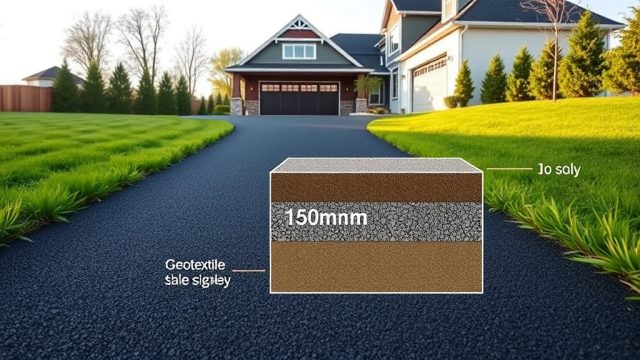
- Soil type: Sandy or gravelly subgrades drain naturally, while clay soils require a 150-200 mm granular drainage layer.
- Compaction: Achieve at least 95% Proctor density for the subgrade to prevent settling, which alters slope.
- Vapour barrier: For high water tables, install a polythene vapour barrier (500 gauge minimum) beneath the asphalt.
Property owners should test subgrade drainage by conducting a percolation test (soakaway test) before any paving work. A failure rate above 30 minutes for water to drain in a 300 mm hole indicates the need for improved drainage—see more in our article on AsphaltPavePro vs. Rust-Oleum EpoxyShield: Comparing Sealcoating Treatment Frequency for Maximum Protection.
What Drainage Systems Work Best Under EpoxyShield-Coated Driveways?
For large driveways or those with challenging topography, integrating a drainage system is essential. The table below compares common subgrade drainage solutions compatible with Rust-Oleum EpoxyShield applications. All costs are in GBP (£).
| Drainage System | Typical Cost (£/m²) | Slope Requirement | Best For | Epoxy Compatibility |
|---|---|---|---|---|
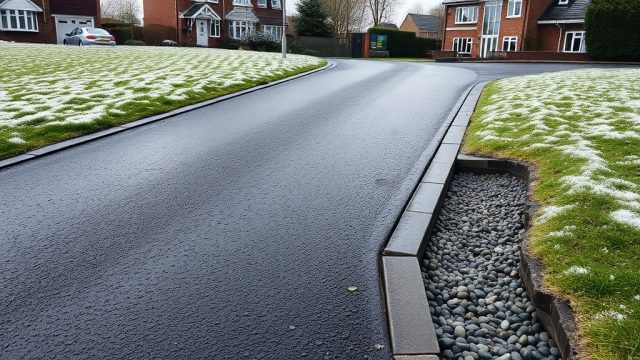
| French drain (perforated pipe in gravel trench) | £15–£30 | 1:100 to 1:50 | Large driveways, high water table | Excellent—prevents hydrostatic pressure |
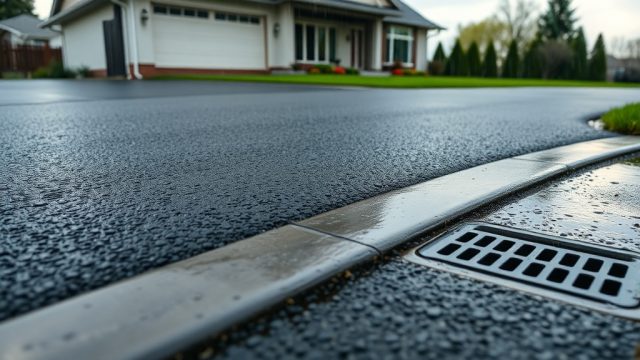
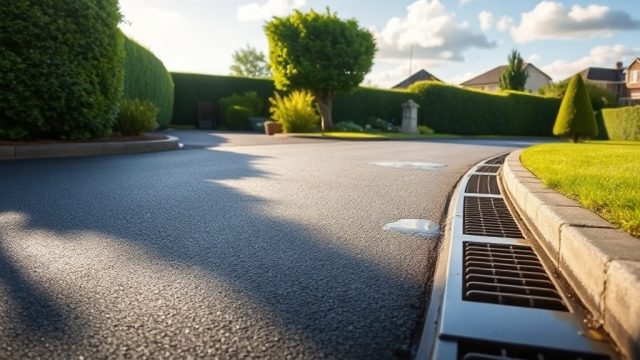
| Linear channel drain (surface-mounted) | £25–£50 | 1:80 minimum | Narrow paths, garage entrances | Good—directs water away from epoxy edge |
| Permeable subbase (open-graded aggregate) | £12–£20 | 1:60 recommended | Standard residential driveways | Very good—reduces water accumulation |
| Soakaway crates (subsurface storage) | £40–£70 | 1:50 to 1:30 | Clay soils, limited space | Excellent—removes bulk water from subgrade |
Choosing the right system depends on the local soil conditions and the driveway’s exposure to runoff. A gravity-fed drainage layout is most reliable for epoxy coatings.
Can Poor Drainage Cause Rust-Oleum EpoxyShield to Fail?
Yes, and the consequences are both visible and structural. When water accumulates under or on the asphalt surface, it creates conditions that directly attack the epoxy bond. Common failure modes include:
- Blistering: Moisture trapped beneath the coating expands when heated by sunlight, forming bubbles.
- Peeling: Prolonged water exposure weakens the epoxy-asphalt interface, causing the coating to lift in sheets.
- Freeze-thaw cracking: Water that seeps into micro-cracks freezes and expands, widening fissures in both asphalt and epoxy.
- Staining: Standing water leaches contaminants from the asphalt, leaving dark marks that cannot be cleaned.
To prevent these issues, ensure the subgrade drainage design includes a minimum 150 mm layer of Type 1 MOT aggregate (certified to SHW Clause 803) beneath the asphalt. This creates a capillary break that keeps moisture away from the EpoxyShield. For high-traffic driveways, refer to Rust-Oleum EpoxyShield Application for High-Traffic Areas: Tips for Durability.
What Is the Cost of Correcting Subgrade Drainage for EpoxyShield?
Addressing drainage issues after the coating has been applied is significantly more expensive than doing it right the first time. Costs in the UK for remedial work can range from £50 to £120 per square metre, depending on the extent of damage. For comparison, a properly designed subgrade drainage system during initial construction adds only £10–£25 per square metre. Here’s a cost snapshot:
- New driveway with proper drainage: £40–£80/m² for subgrade prep (including drainage layer and compaction).
- Rust-Oleum EpoxyShield application: £25–£45/m² (one coat primer + two coats epoxy).
- Remedial drainage installation: £60–£120/m², plus additional £30–£50/m² for coating removal and reapplication.
- Total for failed driveway: Easily over £150/m², compared to £65–£125/m² for correct initial work.
These figures highlight why drainage slope design is a cost-effective investment. For a detailed cost breakdown, see AsphaltPavePro vs. Rust-Oleum EpoxyShield: Cost Analysis for Large Driveway Projects.
What Owners Say About Drainage and EpoxyShield Performance
Homeowners and contractors across the UK report that subgrade drainage is the most overlooked factor in epoxy driveway projects. A contractor from Surrey noted, “I’ve seen EpoxyShield fail within 12 months on a driveway with poor fall. The owner spent £500 on the coating, but £3,000 on drainage repairs a year later.” Another owner from Manchester shared, “We installed a linear channel drain before applying EpoxyShield. Two winters later, the coating is flawless—no cracks, no peeling.”
Common feedback includes:
- Longevity: Proper drainage extends EpoxyShield life from 3–5 years to 7–10 years.
- Appearance: No water stains or discoloration when runoff is effective.
- Maintenance: Less frequent need for resealing—see AsphaltPavePro vs. Rust-Oleum EpoxyShield Sealcoat: Durability Test for Driveways.
- Resale value: A well-drained, epoxy-coated driveway adds 5–8% to property value in suburban markets.
The consensus is clear: drainage slope design is not an optional extra but a prerequisite for EpoxyShield success.
Frequently Asked Questions
1. Can I apply Rust-Oleum EpoxyShield directly to a wet subgrade?
No. The subgrade must be dry to the touch and have a moisture content below 4% for proper adhesion. Applying epoxy to a damp surface will cause bonding failure within weeks.
2. What is the best slope for a drive that receives heavy rain?
A slope of 1:40 (2.5%) is recommended for high-rainfall areas. This ensures water drains rapidly before it can pool or seep beneath the coating.
3. Does Rust-Oleum EpoxyShield itself act as a waterproof barrier?
Yes, the epoxy forms a non-porous surface, but it does not solve subgrade drainage problems. If water accumulates underneath, the coating will delaminate.
4. How long does subgrade drainage construction take for a typical driveway?
For a 40 m² driveway, installing a drainage layer and achieving the correct slope takes 2–3 days, depending on soil conditions and weather.
5. Can I retrofit drainage after applying EpoxyShield?
Yes, but it requires cutting channels through the asphalt and epoxy, which weakens the coating. Retrofitting costs £60–£120/m² and reduces visual quality.
6. Is a French drain better than a channel drain for EpoxyShield?
For subgrade drainage, a French drain is superior because it removes water from beneath the surface. Channel drains only handle surface runoff, so they complement but do not replace subgrade drainage.