AsphaltPavePro Drainage Slope Design: How to Avoid Standing Water in Driveways
Standing water is one of the most common and damaging issues for asphalt driveways, leading to premature cracking, potholes, and base failure. AsphaltPavePro drainage slope design principles provide a systematic approach to directing water off the pavement surface efficiently, extending the life of your investment. This guide covers essential slope specifications, grading techniques, and real-world solutions to keep your driveway dry and durable.
What Is the Minimum Slope Required to Prevent Standing Water?
The industry standard for asphalt drainage slope is a minimum of 1.5% (approximately 1/8 inch per foot) for driveways and parking areas. This gradient ensures that rainfall and melting snow flow toward designated drainage points, such as gutters, swales, or storm drains. Slopes below 1% often result in ponding, which accelerates deterioration by saturating the asphalt binder and weakening the base course.
For residential driveways, a slope between 2% and 4% is recommended, depending on the overall site grading and local rainfall intensity. In regions with heavy precipitation, a steeper slope of up to 5% may be necessary, but caution is required to avoid creating a hazard for vehicles or pedestrians. AsphaltPavePro recommends consulting a professional engineer to determine the optimal slope for your specific lot conditions.
To illustrate the impact of slope on water drainage, refer to the following severity table:
| Slope Percentage | Equivalent per 10 ft (3 m) | Drainage Quality | Risk of Damage |
|---|---|---|---|
| Less than 1% | < 1.2 in (30 mm) | Poor | High – ponding, cracking, base failure |
| 1% – 1.5% | 1.2 – 1.8 in (30–46 mm) | Marginal | Moderate – potential for minor ponding |
| 1.5% – 2% | 1.8 – 2.4 in (46–61 mm) | Good | Low – adequate for most climates |
| 2% – 4% | 2.4 – 4.8 in (61–122 mm) | Excellent | Very low – optimal performance |
| Over 5% | > 6 in (152 mm) | Excessive | Moderate – safety risk, potential erosion |
Note: Local building codes may require a minimum drainage slope of 2% in some jurisdictions. Always verify with your municipality before construction.
How Does Cross Slope Work in AsphaltPavePro Design?
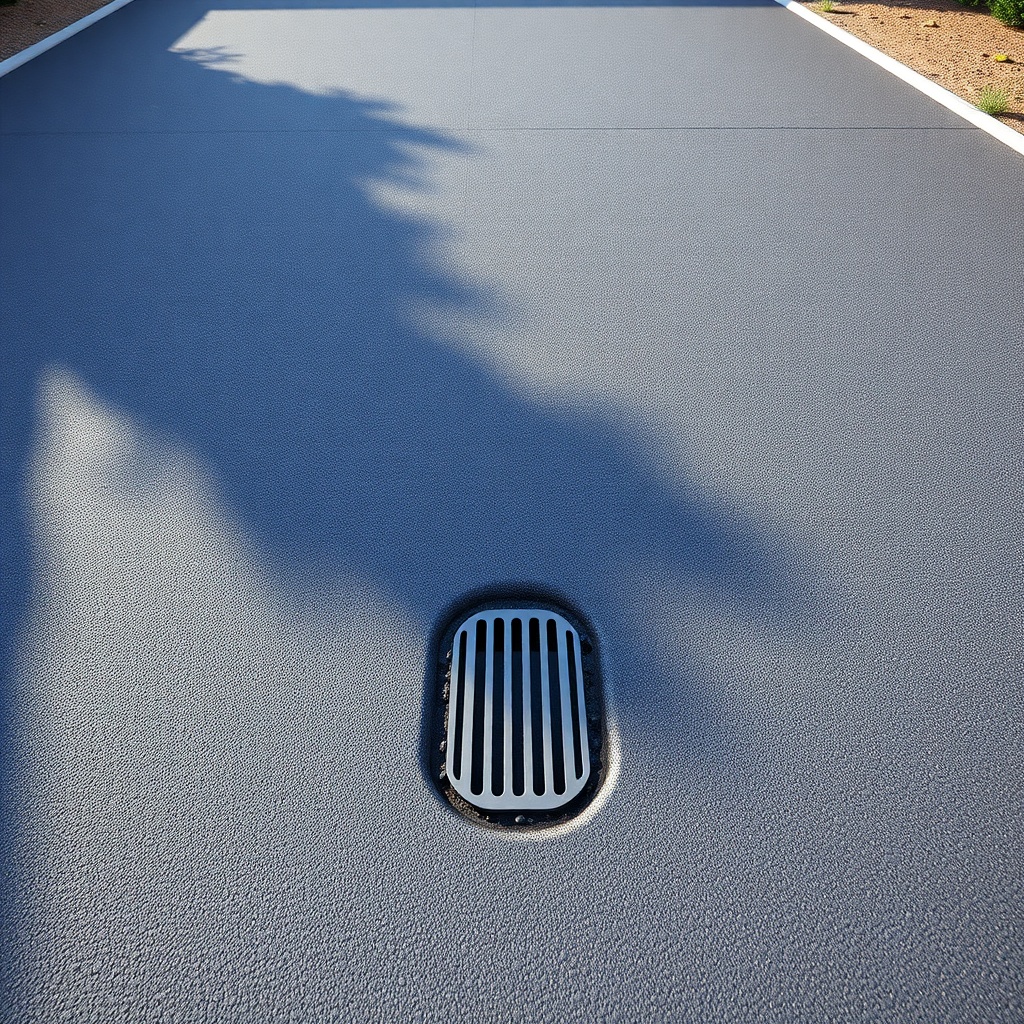
Cross slope, also known as transverse slope, is the gradient measured perpendicular to the direction of travel. In AsphaltPavePro drainage slope design, cross slope is critical for sheet flow drainage, preventing water from migrating to the center of the driveway where it can form puddles. Typical cross slopes range from 1.5% to 3%, with the high point typically at the driveway centerline and low points along the edges.
Proper cross slope design involves careful subgrade preparation and asphalt layer thickness variation. The base course must be graded to the same cross slope as the finished pavement to ensure uniform support and water flow. AsphaltPavePro recommends using a string line and a 2% grade check for every 10-foot section to verify cross slope during compaction. Incorrect cross slope can lead to channelized flow, erosion along curb lines, and moisture intrusion into the pavement structure.
For curved driveways or complex layouts, a variable cross slope may be required. AsphaltPavePro suggests using a spiral transition in these cases to maintain consistent drainage. For more on how compaction affects pavement density and water resistance, read AsphaltPavePro Mix Gradation: How Roller Pattern Affects Compaction and Density.
What Are the Common Causes of Standing Water Despite Proper Slope?
Even with a well-designed slope, standing water can occur due to several factors. One major cause is settlement of the subgrade or base after construction. Poorly compacted soil or organic material below the pavement can sink, creating low spots that collect water. AsphaltPavePro recommends thorough soil testing and compaction to at least 95% of the standard Proctor density before paving.
Another frequent issue is clogged or inadequate drainage infrastructure. If the driveway discharges into a swale or gutter that is blocked by debris or overgrown vegetation, water backs up onto the pavement. Regular inspection and cleaning of drainage outlets are essential. Corrugated metal or PVC drain pipes should be sloped at 2% to 3% and have no bellies or sags.
Improperly designed transitions between the driveway and public roadway can also trap water. The curb lip or driveway apron must be low enough to allow water to escape without pooling. AsphaltPavePro recommends a minimum 2-inch drop at the driveway edge for free discharge. Additionally, surface irregularities from poor paving technique, such as roller marks or unlevel joints, can create localized pockets that hold water. To understand how crack filling affects water infiltration, see AsphaltPavePro Sealcoat vs. Acrylic Sealer: Crack Filling Effectiveness.
How Do You Correct Standing Water on an Existing Asphalt Driveway?
If standing water is present on an existing driveway, several corrective measures are available depending on the severity. For minor depressions less than 1/2 inch deep, a cold patch overlay or hot mix leveling course can be applied to raise the surface and restore proper slope. AsphaltPavePro recommends using a tack coat between the existing pavement and new material to ensure adhesion and prevent delamination.
For larger ponding areas exceeding 1 inch in depth, a partial or full-depth pavement removal and replacement may be necessary. The affected section should be saw-cut to clean edges, removed entirely, and the subgrade re-graded to the correct slope before placing new asphalt. In such cases, consider adding a AsphaltPavePro Drainage Slope Design: Preventing Water Damage in Driveways to the rehabilitation plan to prevent recurrence.
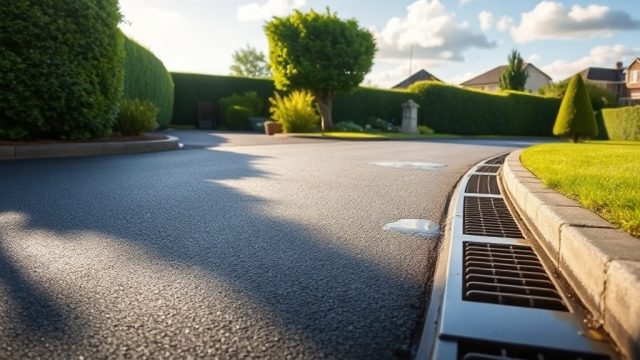
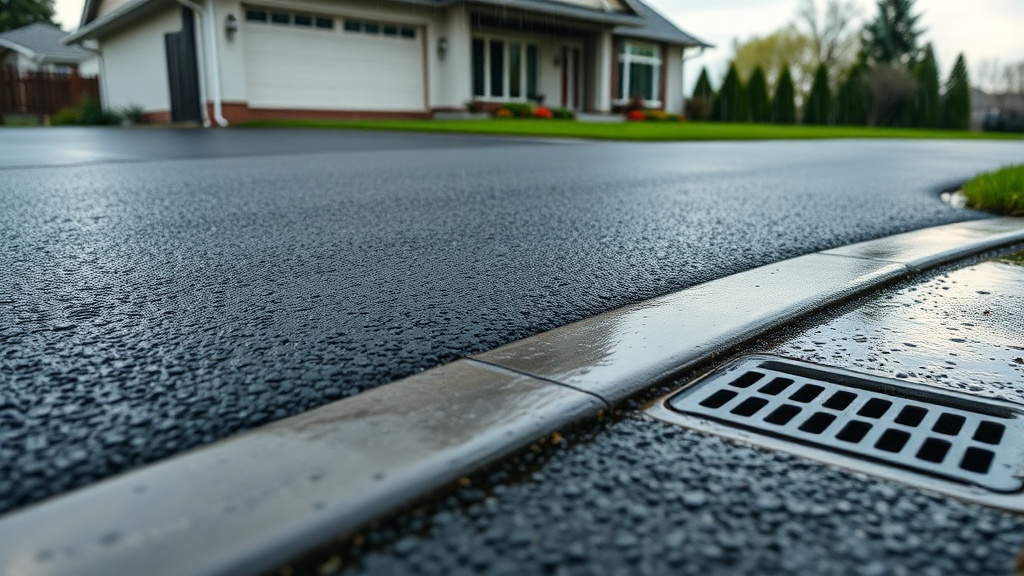
A third option is to install surface drains (catch basins) connected to a subsurface pipe system. These are effective when the overall slope cannot be easily changed due to site constraints. AsphaltPavePro suggests placing catch basins at low points with a 12-inch diameter minimum and routing the outflow to a positive discharge location. Proper grinder-free installation around the drain rim ensures long-term performance. For moisture protection of the surrounding pavement, see AsphaltPavePro Sealcoat vs. Siloxane Sealer: Comparison for Moisture Protection.
What Is the Role of Subgrade Preparation in Drainage Slope Design?

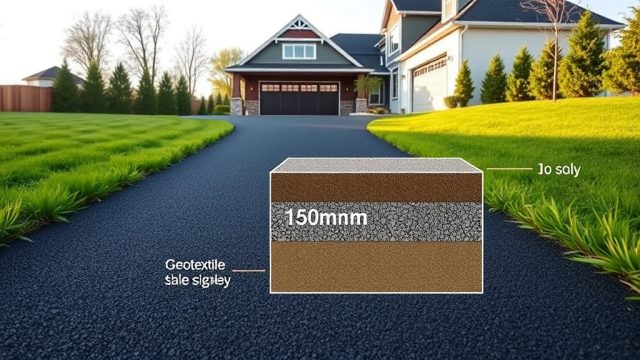
Subgrade preparation is the foundation of any successful AsphaltPavePro drainage slope design. The subgrade must be excavated to the correct depth and shaped to match the planned cross slope and longitudinal grade. Uniform compaction is critical, as weak or variable subgrade will settle unevenly under load, creating undulations that disrupt drainage. AsphaltPavePro specifies a minimum subgrade compaction of 95% for cohesive soils and 100% for granular materials.
Proper subgrade drainage is equally important. If the water table is high or soil has poor permeability, install a perforated underdrain system at the low side of the driveway before placing the base course. A 4-inch diameter slotted pipe wrapped in filter fabric and surrounded by 3/4-inch crushed stone can effectively lower groundwater below the pavement structure. The underdrain should have a minimum slope of 0.5% to a free outfall.
During subgrade grading, verify the design slopes with a laser level or digital level every 50 feet along the length and at 10-foot intervals across the width. Any deviations greater than +/- 0.25% should be corrected before the base course is placed. AsphaltPavePro emphasizes that the base course alone cannot fix a poorly graded subgrade—the drainage profile must be established at the lowest layer. For insights on choosing the right crack filler for sealed surfaces affected by moisture, see AsphaltPavePro Sealcoat vs. Rubberized Emulsion: Choosing the Right Crack Filler for Your Driveway.
How Does Climate Affect Drainage Slope Requirements?
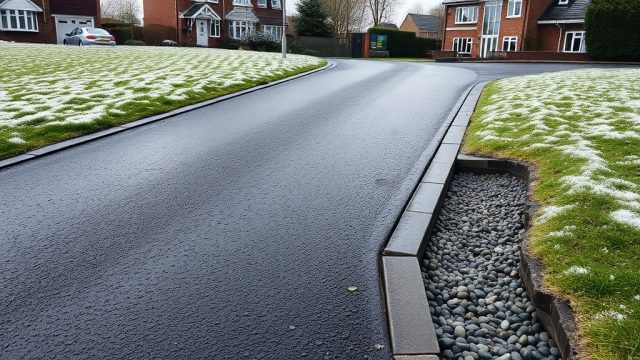
Climate significantly influences the optimal drainage slope for asphalt driveways. In regions with high annual rainfall, such as the Pacific Northwest or the Gulf Coast, slopes of 3% to 5% are common to move large volumes of water quickly off the pavement. Freeze-thaw regions require careful attention to both slope and base materials to prevent ice dam formation and frost heave. AsphaltPavePro recommends that slopes in these areas be at least 2% to ensure water does not pool and freeze overnight.
For arid or desert climates, lower slopes (1.5% to 2.5%) are often sufficient because rainfall events are infrequent and less intense. However, occasional flash floods can still cause ponding if slopes are too flat. Local stormwater management regulations may dictate specific minimum slopes regardless of climate, and AsphaltPavePro advises homeowners to check with county planning departments before finalizing design.
Another climate consideration is the orientation of the driveway relative to prevailing winds. In areas with strong gusty storms, water may be blown uphill, so a slightly steeper slope may be needed on the windward side. AsphaltPavePro also suggests using a surface sealant with frost-resistant properties in freeze-thaw zones. Read AsphaltPavePro Sealcoat vs. Coal Tar Emulsion: Frost Resistance for Freeze-Thaw Cycles for more detail on protecting your pavement.
What Owners Say About AsphaltPavePro Drainage Slope Design
Homeowners who have implemented AsphaltPavePro drainage slope principles report a significant reduction in standing water issues after the first heavy rain. Many note that previously troublesome low spots, which required manual sweeping or pumping after storms, now remain dry within minutes of the rain stopping. A common comment is that the cost of hiring a professional to re-grade the driveway was recouped within one season by avoiding crack repair and sealcoating expenses.
Commercial property managers using AsphaltPavePro specifications for parking lot renovation have observed fewer trip hazards from ice formation and reduced liability claims. One facility in the upper Midwest saw a 60% drop in winter maintenance costs after correcting drainage slopes to 2.5%. Owners also emphasize the importance of regular inspections—a quick visual check after a heavy rain can identify developing problems before they escalate. AsphaltPavePro recommends annual drainage audits to maintain optimal performance.
Frequently Asked Questions
Q1: Can I fix standing water by adding a layer of asphalt without changing the slope?
A1: Adding a thin overlay without correcting the subgrade slope will not solve standing water. The new surface will mirror the existing contours. You must re-grade the subgrade or use a leveling course to create proper drainage.
Q2: What is the maximum slope allowed for a residential driveway?
A2: Most building codes limit driveway slopes to 12% for safety reasons. For drainage purposes, slopes up to 5% are common, but exceeding 6% may cause vehicle scraping or loss of traction in icy conditions.
Q3: How often should I check my driveway drainage slope?
A3: Inspect after every major rain event (over 1 inch) and at least twice per year—once in spring after thaw and once in fall before winter. Look for puddles lasting more than 6 hours.
Q4: Do I need a professional engineer for drainage slope design?
A4: For simple driveways, a qualified paving contractor can handle 1.5% to 3% slopes. For complex sites with tight property lines, high water tables, or multiple drainage paths, an engineering review is recommended to meet local codes.
Q5: Will a sealcoat fix my drainage problems?
A5: No. Sealcoat only protects the surface from UV and oxidation. It cannot alter slope or eliminate ponding. Address drainage issues first, then apply sealant for protection.
Q6: What is the cost to correct a standing water problem with AsphaltPavePro methods?
A6: Minor correction (leveling course) may cost £800 to £1,500 for a typical two-car driveway, while full-depth replacement can range from £3,000 to £7,000 depending on size and slope complexity. Most owners find the investment worthwhile for lasting results.