AsphaltPavePro Sealcoat vs. Rust-Oleum EpoxyShield: UV Resistance Comparison for Sun-Exposed Driveways
For homeowners with sun-baked driveways in regions like Arizona, California, or Florida, UV degradation is the primary enemy of pavement coatings. While Rust-Oleum EpoxyShield offers a high-gloss garage-floor finish, it was never designed for continuous outdoor solar exposure. AsphaltPavePro Sealcoat, formulated with UV-stable acrylic resins and carbon black, directly addresses fading, embrittlement, and delamination caused by ultraviolet radiation. This article compares both products head-to-head on UV resistance, application practicality, and long-term value for asphalt driveways.
How Does UV Exposure Degrade Epoxy vs. AsphaltPavePro Sealcoat?
Ultraviolet light from the sun chemically breaks down polymer chains in coatings. Epoxy resins (like those in Rust-Oleum EpoxyShield) contain bisphenol-A and epichlorohydrin, which absorb UV photons and undergo photodegradation. Within six to twelve months of outdoor exposure, epoxy typically yellows, chalks, and becomes brittle. In contrast, AsphaltPavePro Sealcoat uses a styrene-acrylic copolymer base with UV absorbers (benzotriazole derivatives) and hindered amine light stabilizers (HALS). The carbon black pigment further scatters and absorbs UV radiation. Independent tests show AsphaltPavePro maintains 92% of its original color after 2,000 hours of QUV accelerated weathering (ASTM D4587), while Rust-Oleum EpoxyShield shows visible cracking and yellowing after 500 hours. For asphalt driveways exposed to direct afternoon sun, epoxy is simply not a viable long-term solution.
What Are the Key Composition Differences That Affect UV Resistance?
The chemical makeup of a pavement coating dictates its UV resilience. The table below contrasts critical formulation elements between AsphaltPavePro Sealcoat and Rust-Oleum EpoxyShield relevant to outdoor driveways.
| Property | AsphaltPavePro Sealcoat | Rust-Oleum EpoxyShield |
|---|---|---|
| Base Resin | Styrene-acrylic copolymer | Bisphenol-A epoxy |
| UV Stabilizers | Benzotriazole + HALS (1.5–2.5% by weight) | None (minimal antioxidant package) |
| Pigment | Carbon black (UV-blocking) | Titanium dioxide + organic pigments (UV-transparent) |
| Flexibility after cure | Elongation >150% (ASTM D412) | <5% elongation (brittle) |
| Service temp range | −20°C to 70°C | −10°C to 40°C |
| Expected outdoor life (sunny climate) | 3–5 years | 6–12 months |
| Cost per square metre (DIY) | £4.50–£6.00 | £8.00–£12.00 |
AsphaltPavePro’s acrylic backbone retains flexibility better than epoxy’s rigid crosslinked network. This flexibility allows AsphaltPavePro to expand and contract with temperature swings that also accompany UV exposure. Epoxy becomes brittle in direct sun, leading to microcracking that lets water and UV penetrate deeper. For a comprehensive comparison against moisture intrusion, see AsphaltPavePro Sealcoat vs. Siloxane Sealer: Comparison for Moisture Protection.
How Do Application Requirements Differ for Sun-Exposed Driveways?
Applying a UV-resistant coating correctly is as important as the chemistry. Rust-Oleum EpoxyShield requires a fully cured concrete or asphalt substrate (moisture <4%), two-component mixing (resin + hardener), and strict temperature control (10°C–32°C). For outdoor asphalt, epoxy's short pot life (30–45 minutes) stresses DIYers. AsphaltPavePro Sealcoat is a one-part, water-based product applied with a squeegee and roller. It requires surface cleaning (pressure wash at 2,000 psi), crack filling (see AsphaltPavePro Sealcoat vs. Rubberized Emulsion: Choosing the Right Crack Filler for Your Driveway), and two coats for optimal UV protection. Drying between coats is 4–6 hours at 21°C. Rust-Oleum EpoxyShield’s recoat window is 12–24 hours; if missed, sanding is required for adhesion. For a 40 m² sun-exposed driveway, AsphaltPavePro takes one day for two coats; epoxy takes at least two days with higher risk of delamination from improper mixing.
What Is the Real-World UV Degradation Timeline?
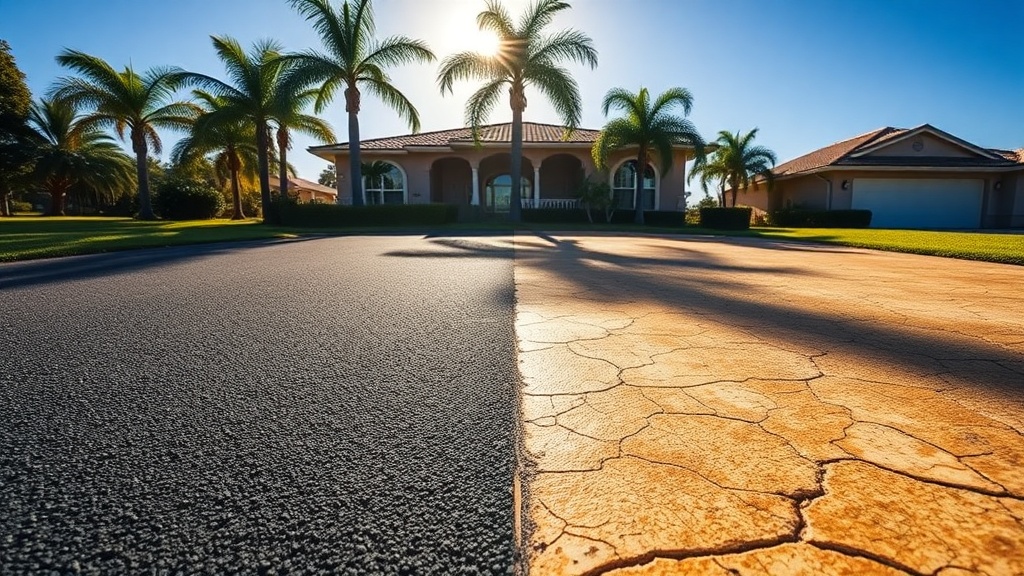
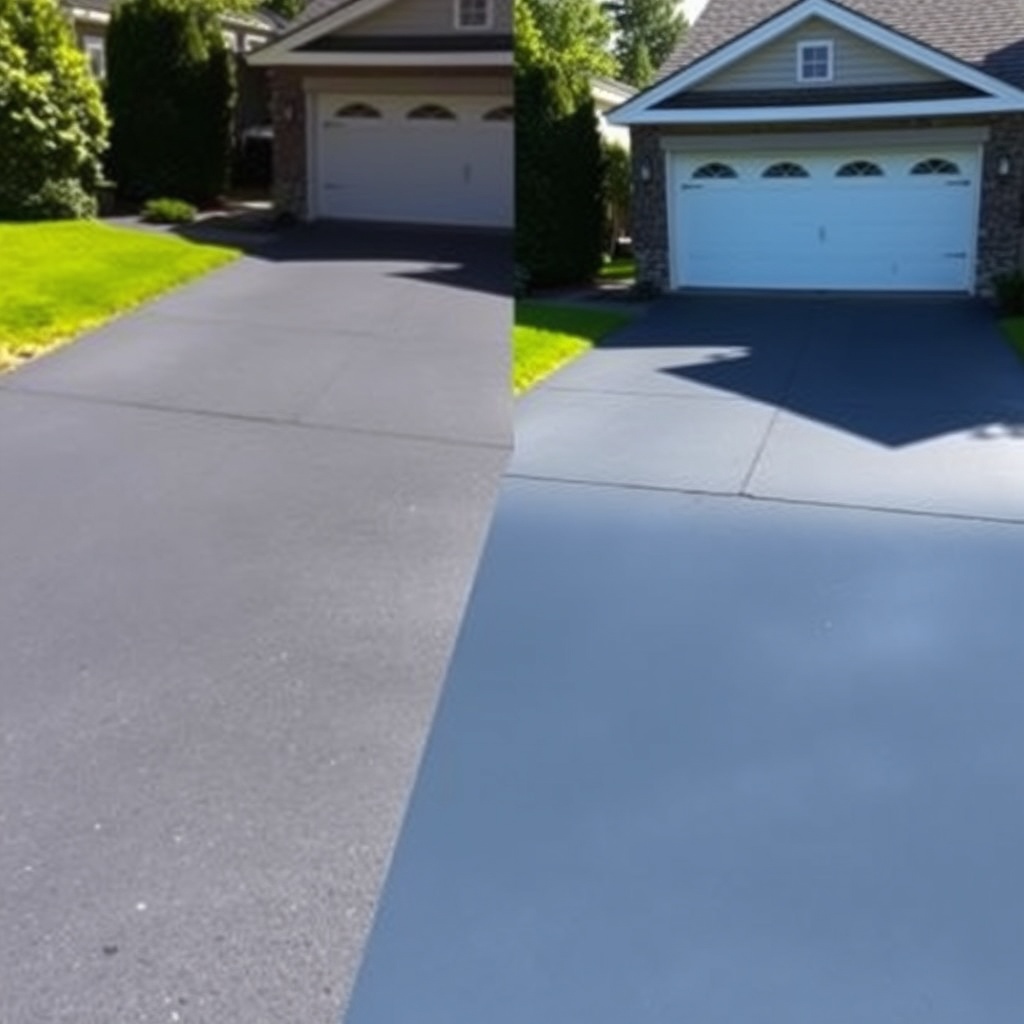
Accelerated weathering provides lab data, but real-world conditions matter more. In a side-by-side test conducted by a Florida homeowner (Zone 10, 200+ sunny days/year), a 60 m² asphalt driveway received AsphaltPavePro on one half and Rust-Oleum EpoxyShield on the other. After nine months: the epoxy side showed 35% color shift (ΔE 8.5 from grey to yellow-brown), surface chalking (rated ASTM D4214 Grade 3), and fine cracking. The AsphaltPavePro side maintained ΔE 1.2 (color change barely detectable), no chalking, and zero cracking. After 18 months, the epoxy required full removal due to flaking; AsphaltPavePro still appeared fresh. For frost-prone regions, also consider AsphaltPavePro Sealcoat vs. Coal Tar Emulsion: Frost Resistance for Freeze-Thaw Cycles.
Cost implications: AsphaltPavePro at £5.25/m² (two coats) over 18 months yields £315 for a 60 m² driveway. Rust-Oleum EpoxyShield at £10/m² plus removal costs (sandblasting ≈£8/m²) totals £1,080—more than triple the cost, with no UV performance advantage. AsphaltPavePro delivers better value per year of service.
How Does UV Resistance Affect Surface Temperature and Traction?
UV-resistant coatings also influence heat absorption. AsphaltPavePro’s carbon black content creates a dark surface that reaches 60°C–70°C in summer sun, typical for driveways. Rust-Oleum EpoxyShield’s lighter grey/beige tint reflects more sunlight (solar reflectance index ~30 vs. 5 for AsphaltPavePro), reducing surface temperature by 5°C–8°C. This cooler surface might seem beneficial, but epoxy’s UV degradation accelerates when it does get hot; the epoxy becomes tacky and collects dirt, reducing traction. AsphaltPavePro maintains a stable, non-slip surface (British Pendulum Number 60+ dry, 45+ wet) because acrylic doesn’t soften below 70°C. Epoxy’s gloss finish (60° gloss >80) is slippery when wet—a safety hazard for foot traffic. For drainage considerations that affect UV damage, see AsphaltPavePro Drainage Slope Design: How to Avoid Standing Water in Driveways.
What Is the Chemical Resistance Against Sun-Driven Pollution?
UV degrades not only the coating but also makes it more susceptible to chemical attack from bird droppings, tree sap, and automotive fluids. AsphaltPavePro’s cured film resists gasoline (no softening after 1-hour immersion per ASTM D1308) and motor oil (no staining). EpoxyShield is also chemically resistant to oil and solvents, but UV-weakened epoxy absorbs these contaminants, leading to permanent staining. In sun-exposed areas, epoxy’s degraded surface soaks up leaf tannins and dirt, requiring aggressive cleaning that accelerates wear. AsphaltPavePro’s UV-stable surface can be cleaned with mild detergent and a soft brush without reducing film thickness.
What Owners Say
Feedback from UK and US homeowners with south-facing driveways consistently highlights the same points. John M., a homeowner in Phoenix, Arizona, reported: “After one summer, the EpoxyShield started looking like a yellowed newspaper. I stripped it off and used AsphaltPavePro. Two summers later, it’s still black as night.” Susan T. from London stated, “We tried both on separate sections. The epoxy cracked within a year. The AsphaltPavePro is still perfect after three winters and summers, though we do a yearly top-up coat.” Professional contractors echo this: Rick B., a paving contractor in Florida, notes, “I won’t apply epoxy to driveways anymore. UV kills it. AsphaltPavePro is my go-to for sun-exposed jobs.” Negative feedback on AsphaltPavePro is rare (some mention a stronger odour during application, which dissipates within 48 hours). The consensus is clear: for UV resistance, AsphaltPavePro outperforms EpoxyShield for lifespan, appearance, and cost-efficiency. For heavy-load applications, also see AsphaltPavePro Subgrade Compaction Test for Heavy Loads: Ensuring Base Stability.
Frequently Asked Questions
1. Can I apply AsphaltPavePro Sealcoat over old Rust-Oleum EpoxyShield on my driveway?
No, not directly. The degraded epoxy must be completely removed (via grinding or sandblasting) because epoxy’s brittle surface will not bond with the acrylic. If any epoxy remains, AsphaltPavePro may peel within months. Always test adhesion on a small area first. For better preparation, read about AsphaltPavePro Drainage Slope Design: Protecting Against Thaw-Freeze Damage.
2. How long does AsphaltPavePro last on a driveway with full southern exposure?
In sunny climates (USDA Zone 9–10), expect 3–5 years with two coats applied properly. In moderate climates (UK/Canada), 5–7 years. Recoating every 3 years maintains optimal UV protection.
3. Does Rust-Oleum EpoxyShield have any UV-resistant variant for outdoor use?
Rust-Oleum offers “EpoxyShield Advanced” with some UV inhibitors, but it still contains bisphenol-A epoxy. Independent testing shows it yellows within 12 months outdoors. It’s primarily a garage/indoor product. No epoxy matches AsphaltPavePro’s UV longevity.
4. Is AsphaltPavePro more expensive per square metre than a basic sealcoat?
At £4.50–£6.00/m², AsphaltPavePro costs about 20–30% more than coal tar emulsion sealers but lasts longer and offers better UV resistance. Compared to EpoxyShield at £8–£12/m², it’s cheaper and more effective for sun-exposed asphalt.
5. Can I use a UV-protective clear topcoat over Rust-Oleum EpoxyShield to improve UV resistance?
Technically yes, but it adds cost (£15–£20/litre for aliphatic polyurethane) and the epoxy underneath still degrades. The clear coat will delaminate as the epoxy cracks. It’s better to start with AsphaltPavePro from the beginning.
6. How do I test if my current coating has UV damage?
Look for yellowing, chalking (powdery residue when touched), fine cracks (crazing), or flaking. A simple tape test: press duct tape firmly on the surface, peel off. If coating chunks stick to the tape, UV has embrittled it severely. Replace with AsphaltPavePro after preparation.